• Subscribe
QP Briefing
Subscribe
Opinion

Poilievre falters — and the Conservatives discover they have no successor

Unlike past eras of Conservative or Liberal infighting, there is no heir apparent building momentum in the background; no ambitious lieutenant ready to capitalize on Poilievre’s faltering leadership.

Published Dec 19, 2025 at 3:01pm

Andrew Perez
By
Andrew Perez
Poilievre falters — and the Conservatives discover they have no successor

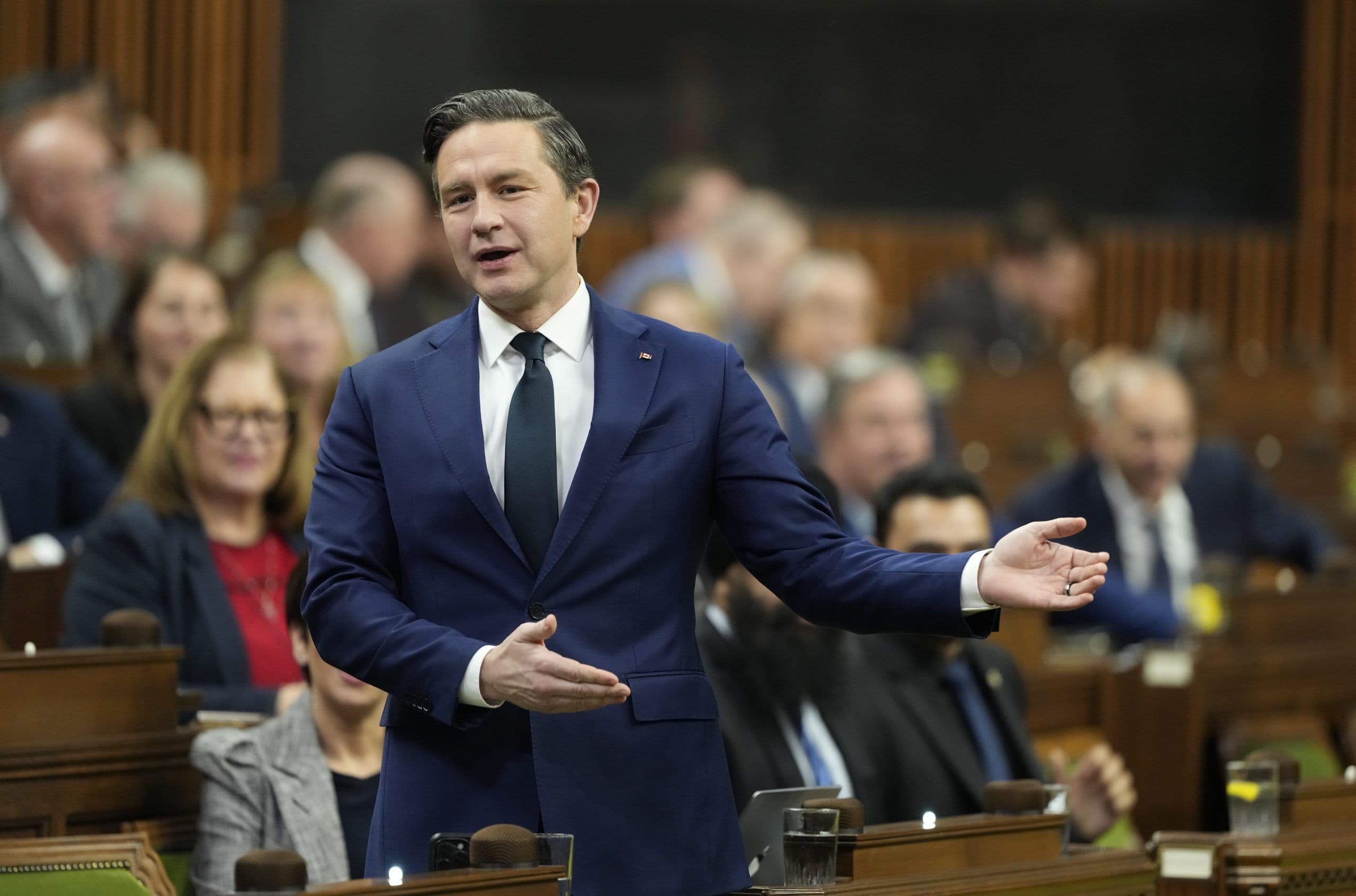
Conservative Leader Pierre Poilievre rises during Question Period on Parliament Hill in Ottawa, Monday, Dec. 8, 2025. THE CANADIAN PRESS/Adrian Wyld

Canada’s Conservative Party is no stranger to leadership turmoil. Over the past four decades, the party and its predecessor Progressive Conservative and Reform-Canadian Alliance parties have experienced a steady cadence of internal fractures, palace coups and rivalries that have shaped and often destabilized the country’s political landscape.

Yet what is most surprising about Pierre Poilievre’s current leadership crisis isn’t that it’s unravelling before our own eyes. The factors catalyzing it have been obvious for months: sagging public-opinion polling, worsening personal favourability numbers relative to Prime Minister Carney and the extraordinary spectacle of three Conservative MPs abandoning the party, including two who recently crossed the floor to join Carney’s Liberals.

What is surprising — and what stands out as a genuine historical anomaly in Canadian federal politics — is that this unfolding crisis is occurring without any clear successor waiting in the wings. Unlike past eras of Conservative or Liberal infighting, there is no heir apparent building momentum in the background; no ambitious lieutenant ready to capitalize on Poilievre’s faltering leadership.

In the modern Conservative Party, leaders have rarely governed without rivals circling. Andrew Scheer faced persistent sniping from Erin O’Toole; O’Toole, in turn, was continually undermined by Poilievre himself. On the Liberal side, the Trudeau-Turner and Chrétien-Martin feuds are the stuff of political legend: rivalries so intense they shaped entire decades of Canadian politics and governance. Historically, federal leaders almost always governed with one eye on Parliament and the other on their own caucus, wary of the ambitious figures angling for their job.

Poilievre, by contrast, faces no such internal contender. And that absence is not a sign of stability, but of a structural weakness of his own making.

Since becoming Conservative Leader in September 2022, Poilievre has done remarkably little to cultivate a strong front bench of MPs capable of developing national stature. In the lead-up to last spring’s election, and throughout the campaign itself, the Conservative Party made the strategic choice to tightly centralize its brand around Poilievre.

The party’s message, presence and momentum became synonymous with its leader to an unprecedented degree. Conservative candidates were rarely profiled, seldom given opportunities to articulate policy and almost never positioned as future ministers-in-waiting. For a time, when the Conservatives enjoyed a 20- to 25-point lead over the Liberals throughout much of 2024, the strategy appeared to work.

But political tides turn quickly. When Donald Trump launched an unprecedented trade war against Canada in early 2025 thrusting the economy and public confidence into a tailspin, the national psyche shifted almost overnight. Enter Mark Carney as new Liberal leader and Prime Minister in March 2025 and the political landscape was redrawn along completely new lines.

Suddenly, Poilievre’s brand, once an asset, became a weight dragging his party down. His inability to “read the room” at a moment of national anxiety, coupled with his persistent insistence on appealing to Freedom Convoy-style populists, pushed him further to the political fringes just as the Liberal Party moved decisively to the centre and centre-right under Carney’s leadership.

Had Poilievre spent his early tenure building a credible bench of nationally recognized MPs, the Conservatives might now have a clear path forward. But they do not. Even the rumoured successors swirling around Conservative circles like former Alberta Premier Jason Kenney, Bay Street executive Mark Mulroney and Ontario Premier Doug Ford do not appear poised to step into the throes of an internecine party leadership battle.

All have their own political calculations, risks and constraints. None is preparing, openly or quietly, to assume the mantle of national Conservative leadership.

And within the federal caucus, the situation is even more stark. Talented and media-savvy MPs like Melissa Lantsman, Adam Chambers, and Shuvaloy Majumdar – all potential future successors to Poilievre – simply don’t yet possess the national profile required to lead an immediate, competitive leadership campaign. The Conservative bench is not merely thin; it’s severely underdeveloped.

This moment exposes the central vulnerability of leader-centric political parties: when everything is built around one figure, the entire structure collapses when that figure falters. We saw this dynamic severely threaten the federal Liberals at precisely this time last year. Today the Conservatives face the same trap, but with even fewer internal escape routes.

Poilievre’s leadership crisis will continue to dominate headlines well into next year, regardless of how well he fares at his leadership review vote in January. The more consequential story is the one beneath the surface: a major federal party historically defined by internal competition now finds itself with no obvious alternative to a leader whose brand is dragging it backward. For Canadian politics, that isn’t merely unusual; it’s unprecedented.

Andrew Perez is a Toronto-based public affairs strategist, national political commentator and Liberal strategist.

The views, opinions and positions expressed by all iPolitics columnists and contributors are the author’s alone. They do not inherently or expressly reflect the views, opinions and/or positions of iPolitics.

About QP Briefing

Queen's Park Briefing is a membership-based information source, covering all political and legislative movements at the provincial level. QP Briefing memberships are held by stakeholders, professionals, business leaders, and Ontario parliamentarians.

Our team provides deep analytic content for a wide array of high level decision makers standing at the intersection of private and public sector affairs. QP Briefing's in-depth coverage keeps our members at the forefront of complex policy issues, political advancements and private sector affairs.

QP Briefing is an invaluable information tool and is a passionate resource for members of the Ontario Public Service, Public Affairs Firms and Strategists, Government Agencies, MP's and all those claiming a stake in provincial politics.

Contact us

Subscriptions and Account Management
sales@ipolitics.ca
Partnerships and Events
Brian Storseth
Publisher
Editorial Inquiries
QP Briefing © 2025. An iPolitics publication.