


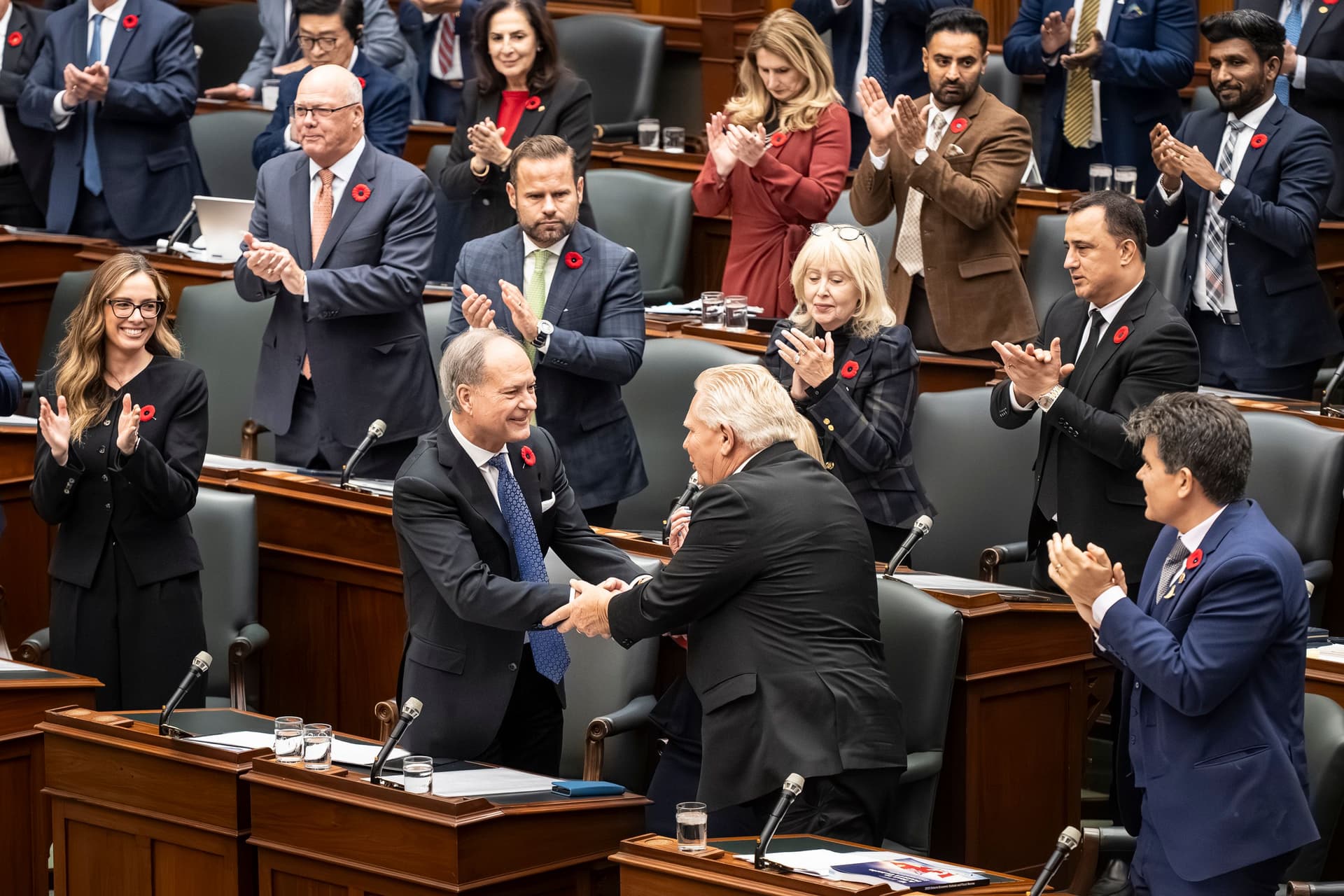
The Ford government is pledging billions in new funding and tax relief in the fall fiscal update to help Ontario businesses grappling with steep U.S. tariffs.
Finance Minister Peter Bethlenfalvy said the government is doubling down on efforts to protect workers and communities by unleashing "Ontario's full economic potential," offering additional financing for trade-exposed sectors and taking the first steps towards overhauling the province's personal and corporate tax regime.
The fiscal update, which details some $234.6 billion in spending, was tabled in the legislature on Thursday and comes days removed from U.S. President Donald Trump halting trade talks with the federal government over Ontario's anti-tariff ad campaign.
Often referred to as a mini-budget, the fiscal plan includes an $100 million injection to a provincial fund that helps businesses find new trade partners, a 5-point temporary increase in the manufacturing tax credit and proposes the creation of new funding streams for sectors reeling from tariffs imposed by the Trump administration.
"Wth tariffs taking direct aim at Ontario workers and communities, it has been more important for the government to deliver on its plan to protect Ontario,” Bethlenfalvy said in a statement.
Despite the headwinds caused by the U.S. trade war, Ontario is on track to report a smaller than anticipated deficit of $13.5 billion this year — a $1.5 billion improvement from estimates earlier this year — and the economy is projected to grow 0.8 per cent in 2025 and 0.9 per cent in 2026, the government said in the fall update.
This would help drive down Ontario's debt-to-GDP ratio to 37.7 per cent this year, a drop of two-tenths of a percentage point from projections in the spring.
The government is still forecasting a deficit of $7.8 billion next year before returning to a small surplus of $200 million in 2027-28.
Faced with an improving fiscal picture, Bethlenfalvy said the government is beginning work on an overhaul of Ontario's personal and corporate tax regime, promising a "tax action plan" in the spring budget.
The government said the reforms would seek to “encourage and attract more business investment, help improve Ontario’s competitiveness in the G7 and help lower costs or provide relief for individuals and families in the years and decades to come.”
The fiscal plan focused mostly on shoring up a jittery provincial economy that has bled jobs in the wake of costly U.S. tariffs, including on steel, aluminium and autos.
“There is a lot of uncertainty out there,” Bethlenfalvy told reporters Thursday afternoon. “I’ve talked to a lot of workers who are concerned.”
Ontario lost 38,000 jobs in the second quarter of 2025, with 29,400 of those coming from the manufacturing sector. The sector recovered some of those losses in September, adding 11,800 jobs, though this was more than offset by a 12,500 decline in positions in the retail and wholesale trade field.
Major automakers like Stellantis and GM have recently announced plans to move or end production of some vehicles in Ontario, and steel producers in the province have warned the Trump administration’s tariffs effectively boxed them out of the U.S., their top market.
The Ontario NDP criticized the economic statement for not doing enough to support Ontarians who have been impacted by recent economic issues.
“Ford’s Fall Economic Statement lacks ambition,” said NDP finance critic Jessica Bell in a statement. “No plan to address the 7.8 per cent unemployment rate and 1 in 5 young people without a job…”
Bethlenfalvy said the government was focusing on providing targeted support for impacted industries, pledging another $100 million to the Ontario Trade Together Fund that helps small- and medium-sized businesses diversify trade partners.
Ontario is planning a temporary increase to the manufacturing tax credit from 10 to 15 per cent and expanding eligibility criteria to cover investments in machinery and equipment.
More funding is expected to flow from the $5 billion Protecting Ontario Fund, a loan program designed to help businesses impacted by tariffs make payroll, lease and utility payments and avoid closures and layoffs.
The first $1 billion allotment focused on steel, aluminium, copper and auto producers. Bethlenfalvy said the province is developing the criteria for two other streams to distribute the remaining $4 billion.
Speaking to reporters shortly after the government presented the update, Ontario NDP leader Merit Stiles and Bell said that the planned programs would not help buttress the impacts the trade war is having on the labour market.
“This Fall Economic Statement fails to deliver for working people,” Stiles said. “The government had an opportunity here to reverse course but that is not what we’ve seen today.”
Green Party leader Mike Schreiner criticized what he saw as an abandonment of the government’s previous environmental targets. Part of the economic statement announced that the Ford government would be changing legislation that requires pursuing and reporting publicly on emissions targets.
“This is essentially telling the people of Ontario that they don’t care,” Schreiner said. “They have no plan whatsoever to diminish climate pollution and today they’re admitting it.”
The Ford government teased out some measures of the fall fiscal update prior to introduction in the legislature, including an expanded HST rebate for first-time buyers on new homes valued at $1 million or less.
It matches the language of the federal Liberal government’s expanded GST rebate for new home purchases.
The government is also committing $1.1 billion over the next three years to extend homecare services.
The fall fiscal update was released only days after the federal Liberals tabled the first ever budget of Mark Carney's tenure as prime minister.
with files from Thomas Desormeaux