

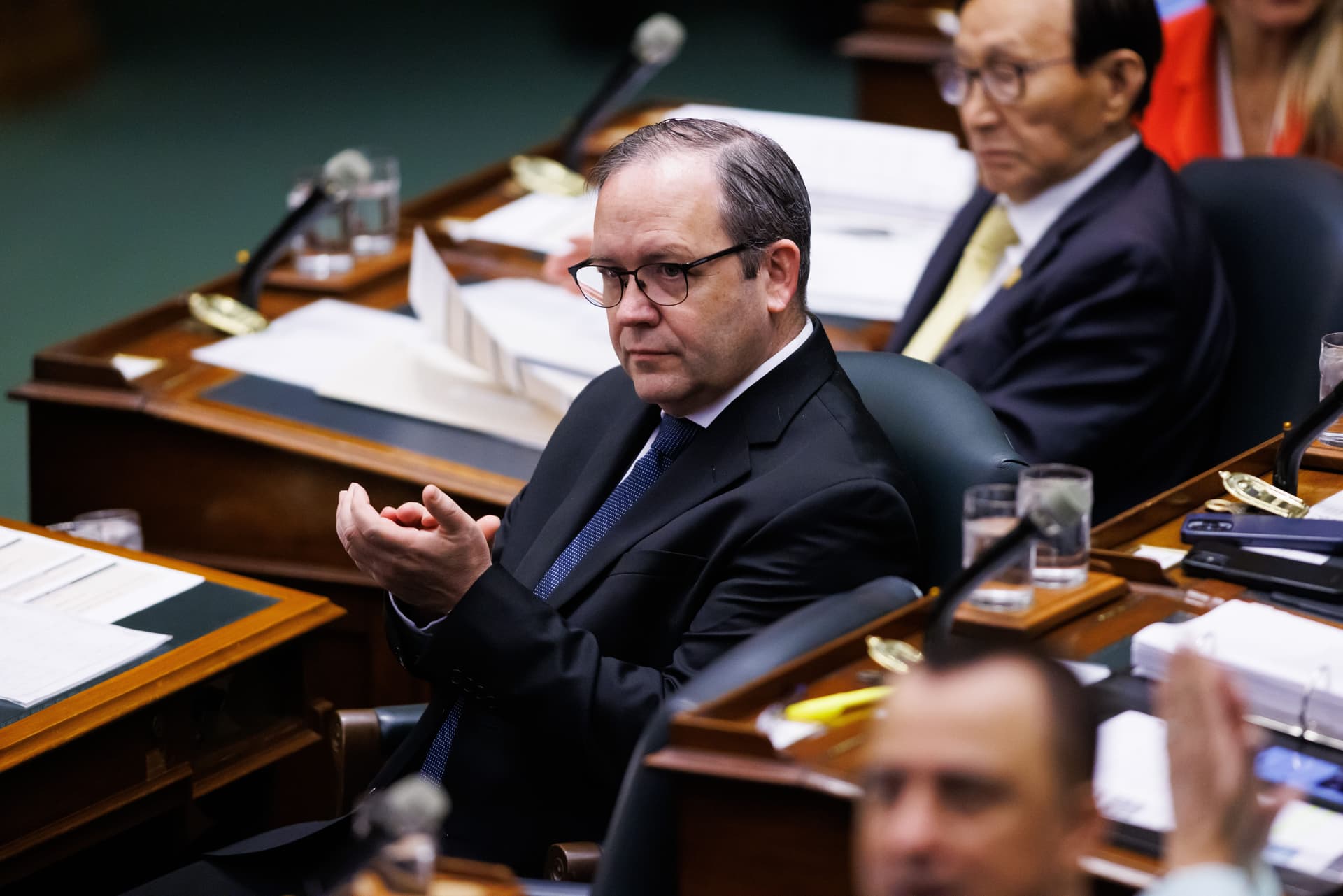
Ontario’s Attorney General Doug Downey gave a speech Thursday about his government’s move to digitize large parts of the province’s court system.
Speaking to an audience at the Empire Club of Canada, Downey touted the success he says the Ford government has had moving certain court hearings online.
“Now, we started in 2021, this is where the count starts,” the Attorney General said. “As of August, we’ve had 11 million virtual and hybrid hearings, 11 million in that time: four years. And today, we have 195 courtrooms fully equipped to support those hybrid hearings.”
Downey said that the process involved a lot of training for court staff and the judiciary and that the government hopes to upgrade a total of 338 courtrooms with the necessary audio and visual equipment by the end of 2026.
Ontario’s justice system adopted virtual court hearings in 2020 due to the physical distancing rules caused by the COVID-19 pandemic. The Ford government introduced several measures, beginning in 2021, to help move some parts of the court system online in an effort to “help reduce delays and backlogs at tribunals.”
Canada’s court systems have faced inordinate delays for years. In 2021, former Chief Justice of the Supreme Court of Canada Beverley McLachlin referred to it as an “access to justice crisis.”
This is part of what the Progressive Conservative government said it was trying to address with its expansion to online services that same year.
“Our system, is built on a lot of history, it’s built on a lot of tradition and is one of the most respected legal systems in the world.” Downey said in his preamble to the speech this week. “…but as the world changes, and as technology evolves and communities grow, tradition alone is not enough to carry us forward. We need to take bold action.”
Ontario rolled out new online options for access to provincial court systems earlier this autumn. Phase one of its “Ontario Courts Public Portal” went live for Toronto only in mid-October and expanded online access to cases in several types of non-criminal courts. The province plans to expand the program to criminal matters in 2027 and hopes to roll it out across Ontario in 2030.
Solving judicial delays was a key part of each party’s election campaign last winter.
In November 2024, Kristyn Wong-Tam, NDP MPP and Opposition Critic for the Attorney General, introduced a bill to create “backlog reduction panels” and invest in expanded legal aid services in Ontario.
Downey said that his government is focused on three other important initiatives in hopes of making the justice system more efficient: expanding the number of lawyers who can work in legal aid, paying jurors more money and increasing the number of judges in Ontario.
Throughout, Downey and his associates, like Sean Weir, the Executive Chair at Tribunals Ontario, talked about the importance of shifting certain parts of the justice system onto the internet. Tribunals Ontario consists of 12 adjudicative tribunals and operates under the authority of the Attorney General.
When it came to the possible use of artificial intelligence in Ontario’s court sphere, Weir said that will be likely be the next step but that it will be important to proceed cautiously.
“I think a major of focus has to be on AI,” Weir said. “We’ve got a lot of work to do to decide where it should be and how it should be used. We need to harness it for the right reasons, but we can’t give away the backbone of our system to do something like that.”